

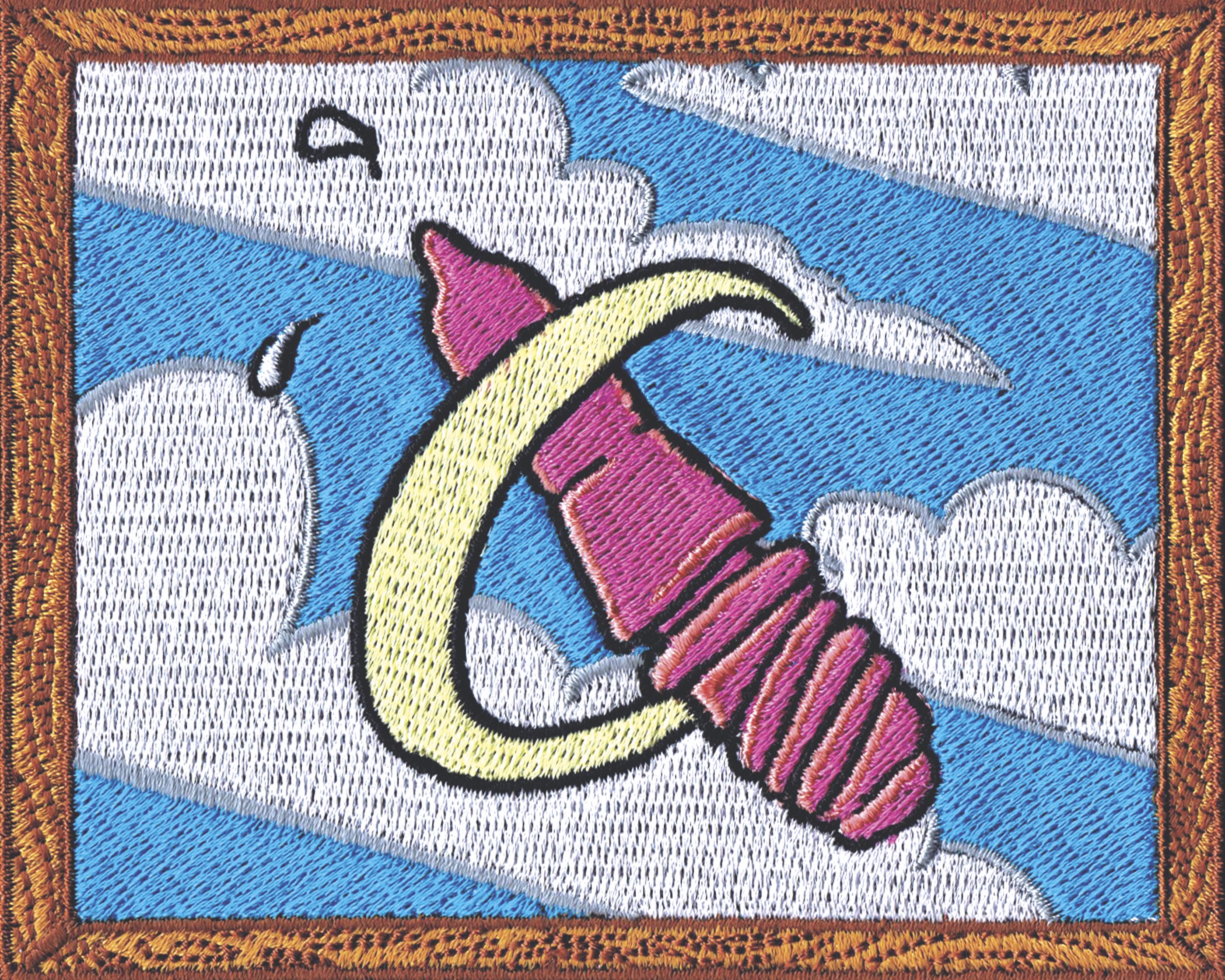
Daphne Simons’ Peach Teats at the Dude Ranch covered the six Te Tuhi billboards across their two locations on Reeves Road and at Parnell Station, making them look at once like embroidered patches and the bright displays of a pokie machine. One board depicts a throbbing, mutant organ—a cross between a heart and an upturned udder. Another, the snout of a cow, lustfully licking its lips. The remaining four show the Peach Teats products—the silicone teats for calf feeders made locally famous by the company’s iconic marketing campaign—though Simons has made some important additions.
Squirting from the feeders are big droplets of milk. These, says Simons, are a reference to the MAdGE (Mothers Against Genetic Engineering) billboards of the early 2000s, in which milk was an important motif. Blazoned across one was the slogan, “KEEP OUR MILK G.E. FREE”; beneath it sat a row of cross-legged mothers wearing latex cow masks. Another depicted a nude woman crouching provocatively on her hands and knees, her full breasts swinging beneath her, all four of them cupped in industrial suckers. Like the Peach Teats billboard on State Highway 1 in the central North Island, the MAdGE advertisements flouted the usual borders between human and livestock, sexuality and agriculture; only the result was no cheeky comedy, but a form of body horror.
The main problem with MAdGE’s imagery was its reliance on a deeply conservative model of femininity. By articulating ‘crimes against nature’ as ‘crimes against (traditional) motherhood’, the MAdGE billboards equated the two, naturalising a historically contingent gender identity. In this, they perpetuated an age-old theme in the rhetoric against scientific hubris. Mary Shelley’s Frankenstein is an early example; the chief offence of the eponymous doctor lies in the fact that, by giving life, he usurps the role that ‘nature’ has assigned to women (an offence made dramatically clear by the sudden and mysterious deaths of all the novel’s mothers and mothers-to-be). Defying this tradition, Simons has modelled the squirting feeders so that they explicitly resemble ejaculating phalluses. It’s a resemblance that allows Peach Teats at the Dude Ranch to efface not only the borders between intimacy and industry, pleasure and (the dairy) business, but also those between ‘male’ and ‘female’, ‘natural’ and ‘unnatural’.
But the milk/cum confusion is also an allusion to the Got Milk? campaign; and while that campaign was never explicitly sexual, its parodies certainly were. In Peter Segal’s 2000 film The Nutty Professor II, Buddy Love (Eddie Murphy) drinks an age-reversing formula, turns into a baby, falls into the bosom of Playboy Playmate Julia Schultz, then utters the slogan, “Got Milk?” The joke (if we can even call it that) lies in conflating the pleasure the infant finds in being breastfed and that which the adult, heterosexual male finds in cleavage. Something similar occurs in the video for Fergie’s 2016 song ‘M.I.L.F. $’, which features an entire suburb of young mothers sexily re-enacting the famous scenes from the Got Milk? adverts. Only there’s no joke. Fergie—un-like, say, Doja Cat, with her 2018 single ‘MOOO!’—conveys no sense of irony, but seems to be presenting an earnest fantasy for an assumed heterosexual male viewership. Among such works, Simons’ billboards are closest to the performances of Gottmik, the first openly trans man to compete in Ru Paul’s Drag Race, whose allusion to dairy-industry PR is of an entire system of signs designed to wreak havoc on the familiar narrative: the farmer who wants a wife.
Simons has also encircled the feeders with large crescents. “These came from some sketches I was doing of different cow breeds … I would automatically glamorise those yellow identifier tags dairy cows usually have, and turn them into these big golden hoop earrings.” But don’t the teats and tags look a lot like hammers and sickles? “The communist flag connotation really sang out to me … I like that this reference rubs up against the intentional ‘Wild West’ slot-machine-style graphics, and their connections to luck and aspirational fortune.”
On the face of it, the boom-and-bust cycles of the frontier, in which whole fortunes were lost and won each week, have little to do with playing the pokies on a Saturday night. But both are ultimately modes of gambling, and forge a continuity between capitalisms old and new. Communist iconography might seem out of place here—a near-violent intrusion on that continuity, and a jarring admonition against leaving things to luck and fortune. Like every good gate-crasher, though, this imagery finds itself at home: like Peach Teats feeders and yellow ID tags, hammers and sickles are the tools of industry and agriculture. Demanded by this (in)appropriate imagery is no revolution as such—no full-scale dismantling of the libidinal/agrarian economy—but a subtler reconfiguration of its values: a queering of husbandries.



N.B. This article has been amended from the printed version which misstated the artists’ pronouns


